
By Philly Wellness Center
The “normal hormone levels” on a lab report are a reference range, and the numbers vary from lab to lab. A reference range is built from the results of a large group of healthy people, usually the middle 95 percent. So for any one test, about 1 in 20 healthy people land outside it. It is not a personal target.
The short version
- A reference range is built from the test results of a large group of healthy people, usually the middle 95 percent of those results.
- By design, for any one test, about 5 in 100 results from healthy people fall outside the range and are flagged.
- Labs use different methods, so the range that applies is the one printed beside the result.
What is a reference range on a hormone lab report?
A reference range is the pair of numbers printed beside a result. MedlinePlus, the National Library of Medicine’s health site, describes it as the high and low ends of the results considered normal, based on test results from large groups of healthy people. Labs set their own ranges, so the one that applies is printed on that same report.
The same test can carry different ranges for different groups, such as children and adults. MedlinePlus puts it plainly: “Because these ranges can vary, the term ‘normal’ can be misleading.”
A range helps a clinician see when a result sits far from what is common in the reference group. That is useful. It is not a verdict on one person.
How does a lab build a reference range?
A lab tests a group of healthy people, chosen with health questions, and lines up their results from lowest to highest. It usually keeps the middle 95 percent. The lower limit is the 2.5th percentile, the point with 2.5 percent of the group’s results below it. The upper limit is the 97.5th percentile.
A widely used guideline recommends at least 120 people in each group. It comes from the Clinical and Laboratory Standards Institute and the International Federation of Clinical Chemistry (document C28-A3). A 2016 review in the journal Biochemia Medica calls it the most widely used source on the subject. Among other things, the guideline covers:
- Choosing the group. People are screened with a questionnaire, and some are left out for reasons that would skew the results.
- Borrowing a range. A lab may adopt a range from a test maker or another lab. The guideline asks it to check that range first against 20 people from its own population. If no more than 2 of the 20 fall outside it, the range may be adopted, at least provisionally.
The same review adds that, ideally, ranges are set separately by age, sex and ethnicity where those change the result.
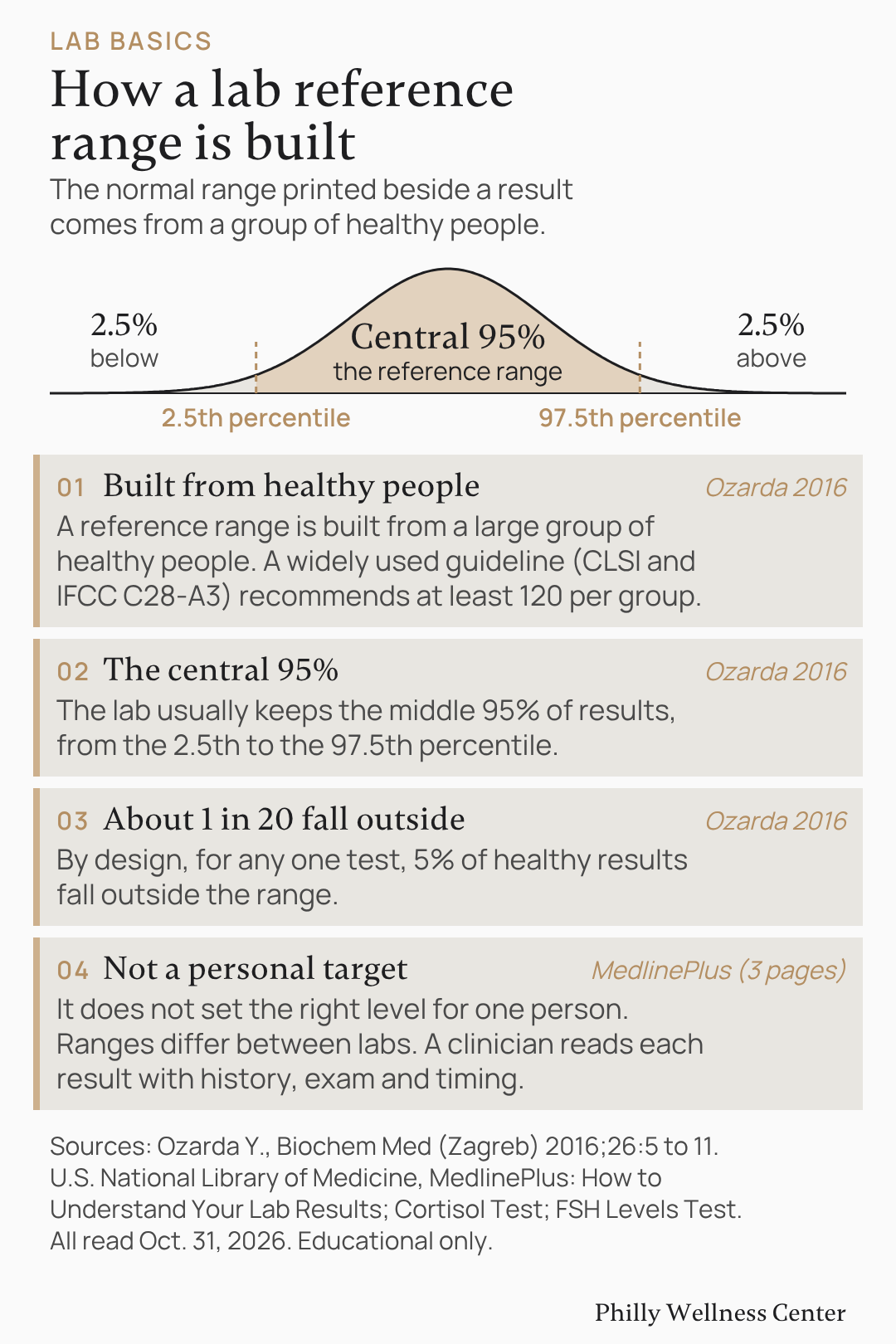
How a lab reference range is built. Sources: Ozarda, Biochemia Medica 2016; U.S. National Library of Medicine, MedlinePlus.
Why do about 1 in 20 healthy people fall outside the range?
Because the range is built that way. Keeping the middle 95 percent of the reference group’s results means that, for any one test, 5 percent of them sit outside it, about 1 in 20, and get flagged. MedlinePlus says it is common for healthy people to sometimes have results outside the reference range.
A flag on its own is a prompt, not a conclusion. MedlinePlus says a result above or below the range “may or may not be a sign of a health problem.” When a result sits outside the range, the provider looks at other information about the person’s health to understand what may have affected it.
Why can one hormone result differ from the next?
Many hormones move on a schedule, so one blood draw shows one moment. Cortisol is normally highest in the morning and much lower by late afternoon. FSH, a hormone that helps control the menstrual cycle, changes through the month. The time of the draw is part of the result.
That is why a lab may ask for a sample at a set time. For cortisol, blood is often drawn twice in one day, once in the morning and again around 4 p.m. For FSH, women who have periods may be tested at a specific time during the menstrual cycle.
Life stage matters too. MedlinePlus describes perimenopause as the time leading up to menopause when hormones and periods begin to change, usually starting around age 45. A single number from that stretch of life is read as a snapshot, not a full story.
Why do two labs print different ranges for the same test?
Labs often use different testing methods, so they set different ranges. Results may also be reported in different units. MedlinePlus says a result should be compared only with the range listed by the lab that ran it. When a result is followed over time, it helps to use the same lab each time.
This is also why this article prints no hormone ranges. MedlinePlus says its own test pages cannot provide normal reference ranges for most tests, for the same reason. A number copied from a website may not match the lab that ran the test.
What does a clinician look at beside the number?
The whole picture. Lab tests do not give a complete picture of health on their own, so a provider reads results together with the physical exam, health history, family health history and any imaging. At Philly Wellness Center, treatment is individualized based on symptoms, laboratory findings, medical history, and ongoing monitoring.
Timing is part of that picture: when the sample was drawn, and where it falls in a cycle or a stage of life. So is the person’s own record. Results from earlier tests at the same lab show whether a number has moved, which a single range cannot show.
What makes a hormone test useful?
A useful hormone test is planned around how that hormone behaves. That means a draw timed to the hormone, such as morning and afternoon samples for cortisol or a set time in the menstrual cycle for FSH. It means using the same lab each time. And it means several results over time, which build a personal baseline.
A test answers a question, and the question comes first.
What a reference range does not tell you
A range is not proof of good health. MedlinePlus says a result within the range does not always mean good health, and that some people with health problems have results considered normal. The range also leaves out three things that matter when a result is read:
- It is not a personal target. The range shows where most of the reference group lands. It does not define the right level for one person.
- It is not a decision line. The 2016 review in Biochemia Medica separates reference ranges from clinical decision limits. Decision limits are set by consensus for a specific medical question, and the review warns that the two should not be confused.
- It does not show one person’s own pattern. The same review explains that, for many tests, one person’s results move within only part of the population range. A change for that person can stay inside the range and go unnoticed. Several results from the same person, taken when nothing about the person’s health has changed, can form a personal baseline to compare against.
Where to start at Philly Wellness Center
The clinic’s RESET™ Assessment is its lab-based starting point, and it ends in a personalized RESET Roadmap. Hormone care, including bioidentical hormone therapy in Philadelphia, is led by Catie Harris, PhD, MBA, CRNP, a nurse practitioner. The clinic is at 834 South St, Philadelphia, PA 19147. Philly Wellness Center is a cash-pay practice.
Book a free 15-minute phone call with the clinic’s patient coordinator
Or call (215) 709-9710.
Educational only, not medical advice.
Sources
- U.S. National Library of Medicine, MedlinePlus. “How to Understand Your Lab Results.” Last updated September 4, 2025. Read October 31, 2026. medlineplus.gov/lab-tests/how-to-understand-your-lab-results
- U.S. National Library of Medicine, MedlinePlus. “Cortisol Test.” Last updated December 23, 2024. Read October 31, 2026. medlineplus.gov/lab-tests/cortisol-test
- U.S. National Library of Medicine, MedlinePlus. “Follicle-Stimulating Hormone (FSH) Levels Test.” Last updated December 4, 2023. Read October 31, 2026. medlineplus.gov/lab-tests/follicle-stimulating-hormone-fsh-levels-test
- Ozarda Y. “Reference intervals: current status, recent developments and future considerations.” Biochemia Medica (Zagreb). 2016;26(1):5 to 11. doi:10.11613/BM.2016.001. Read October 31, 2026. biochemia-medica.com