No. Philly Wellness Center is a cash-pay practice and does not participate with insurance.

Perimenopause Treatment Philadelphia
Care through the transition, on South Street in Philadelphia.
Consultation required
Yes. It starts with a free 15-minute call.
Where
834 South St, Philadelphia
Who leads care
Catie Harris, PhD, MBA, CRNP
Payment
Cash pay; the clinic does not participate with insurance
How care starts
- A free 15-minute call with the patient coordinator
- A consultation with Catie
- Blood panels chosen for the individual
- A plan, monitored over time
Perimenopause treatment at Philly Wellness Center is care for adults in the transition before menopause, led by Catie Harris, PhD, MBA, CRNP, a nurse practitioner. It starts with a free 15-minute call, then a consultation and lab work, then a plan that is individualized and checked at regular visits. The clinic is at 834 South St, Philadelphia, PA 19147.
Perimenopause care
How care works here
Perimenopause care at Philly Wellness Center starts by listening, then measuring. Catie looks at the whole person, not just one symptom, and takes the time to explain what the labs show in plain words.
Lab work is chosen for the individual, and the plan is built around it. For hormone therapy options, see Bioidentical Hormone Therapy Philadelphia.
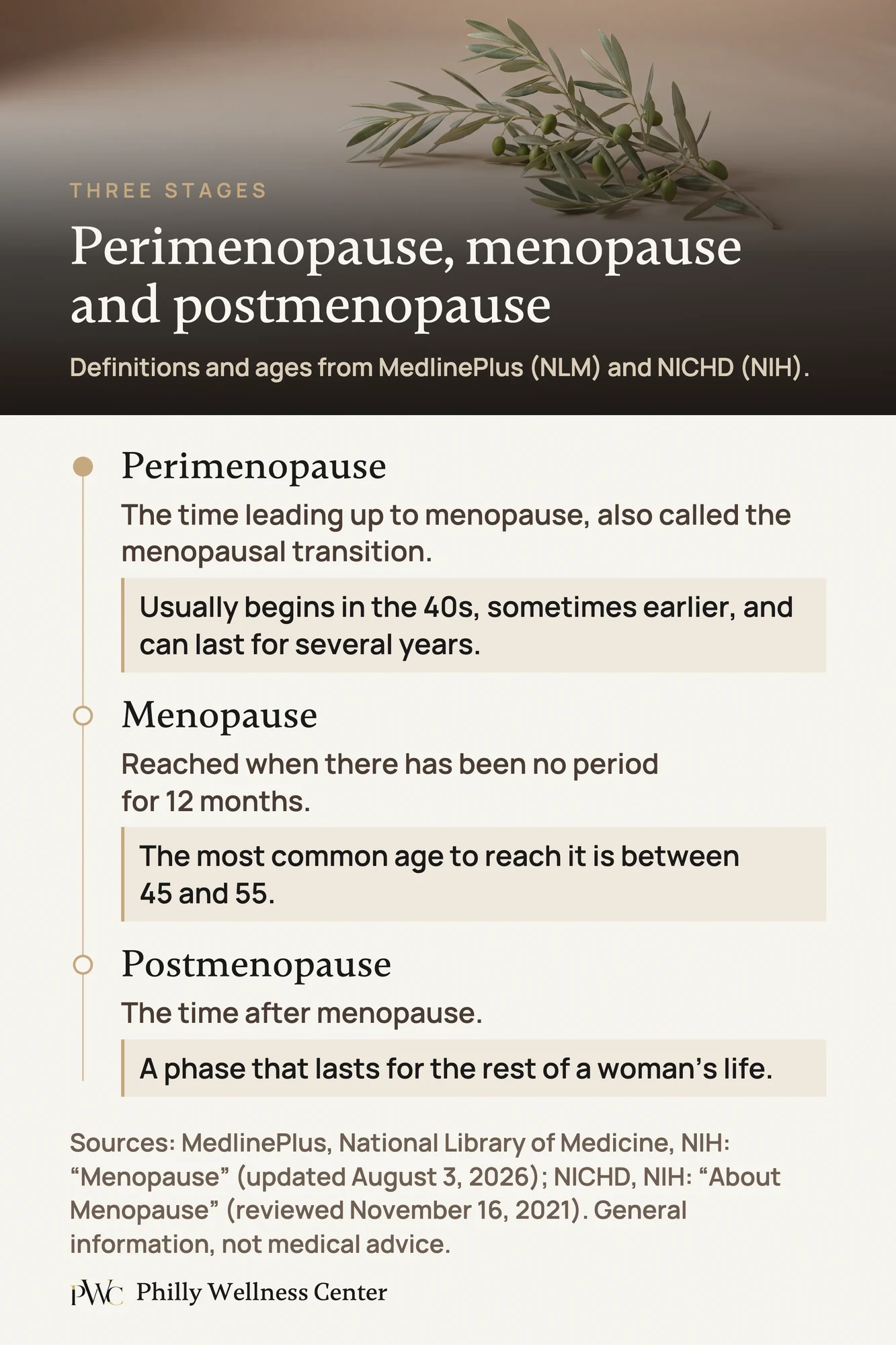
Infographic header photo: AI-generated illustration.
- A free 15-minute call. A phone call with the patient coordinator about goals and what the clinic offers.
- A consultation. A visit with Catie Harris, PhD, MBA, CRNP, to go through health history, goals and questions.
- Labs. Catie chooses the lab work.
- A plan and ongoing monitoring. Catie goes through the labs and builds a plan around them. Follow-up labs show what has changed, and the plan is adjusted.
Perimenopause, menopause and postmenopause
Perimenopause is the time leading up to menopause, also called the menopausal transition. MedlinePlus, from the National Library of Medicine, says it usually begins in a woman’s 40s, sometimes earlier, and can last for several years. Menopause is reached when there has been no period for 12 months, most often between ages 45 and 55.
The time after menopause is called postmenopause, a phase that lasts for the rest of a woman’s life, according to the National Institutes of Health. For menopause care, see Menopause Treatment Philadelphia. How long menopause lasts is covered in Understanding Menopause: Exactly How Long Does Menopause Last?
Who is this service for, and who is it not for?
This service is for adults in the perimenopause transition who want care built around in-person visits and lab work, with a provider who explains things in plain words. It suits people who want to understand what is changing and want an individualized plan that is checked over time.
It is not the right fit for anyone who wants to use insurance, or anyone looking for a prescription without a consultation and lab work. Hormone therapy is not used with some health histories; MedlinePlus lists them, and they are reviewed at the consultation.
What happens at the first visit, and after it?
After the free call, every plan begins with a consultation and comprehensive labs. Catie goes through health history, goals and questions, and chooses the lab work. When the labs are back, she explains them in plain words and builds a plan. Ongoing care continues with regular check-ins.
The clinic is cash pay. Questions about cost? Ask on the free 15-minute call.
What are the risks and side effects of hormone therapy?
Hormone therapy has benefits and risks. MedlinePlus says that for some women hormone therapy may increase the risk of blood clots, heart attack, stroke, breast cancer and gallbladder disease. The level of risk depends on the type of therapy, how long it is used, and medical history and lifestyle. These are reviewed at the consultation.
MedlinePlus also explains that for women who still have a uterus, a provider may recommend a combined form of hormone therapy.
For appropriately selected adults, hormone therapy may improve symptoms associated with hormonal decline. Treatment is individualized based on symptoms, laboratory findings, medical history, and ongoing monitoring.
How does this compare with waiting it out?
Waiting is one option. MedlinePlus notes that treatment for menopause symptoms may not be needed, and that some symptoms can be managed with lifestyle changes. Care here is for people who would rather understand what is changing, with labs and a plan, and decide with a provider.
Why visit the clinic on South Street?
Perimenopause care here is led by Catie Harris, PhD, MBA, CRNP, a nurse practitioner with 25+ years in neurosurgery, functional medicine and longevity. She is the author of RESET: The Mito Kitchen and Why Didn’t Anyone Tell Me This?, and she hosts a podcast.
The clinic is at 834 South St, Philadelphia, PA 19147. There is street parking, or patients can park for free at Whole Foods. Office hours are Monday to Saturday, 10am to 5pm, and the clinic is closed on major holidays. Call (215) 709-9710 or book a free 15-minute call.
Questions before booking
The patient coordinator. It is a free 15-minute phone call about goals and what the clinic offers. After the call, the next step is ideally a consultation on Catie’s schedule.
Yes. Booking online is preferred, and the front desk can also book at (215) 709-9710.
Online, at any time.
Sources
- MedlinePlus, National Library of Medicine, National Institutes of Health. Menopause. Updated August 3, 2026.
- MedlinePlus, National Library of Medicine, National Institutes of Health. Hormone Therapy for Menopause. Updated July 24, 2026.
- Eunice Kennedy Shriver National Institute of Child Health and Human Development, National Institutes of Health. About Menopause. Last reviewed November 16, 2021.
Treatment is individualized based on symptoms, laboratory findings, medical history, and ongoing monitoring. This page is for general information and is not medical advice.



Ready When You Are
Pick Your Next Step
Book a consultation, build a treatment plan, or just send us a message. Whichever way you start, you will talk to somebody who sees the whole picture.