Featured photo: AI-generated illustration.
By Philly Wellness Center
Many women gain weight around menopause, says the U.S. Office on Women’s Health. The hormone changes of menopause can affect weight, muscles and sleep, and muscle mass also declines naturally with age. Everyday factors such as calories, activity and sleep matter too, so menopause is one part of the picture.
The short version
- Falling hormone levels at menopause affect how muscles use energy and contribute to an increase in abdominal fat, says the U.S. Office on Women’s Health.
- Federal guidelines advise adults to get 150 to 300 minutes of moderate activity a week, plus muscle-strengthening activity on 2 or more days.
- The National Heart, Lung, and Blood Institute says experts recommend 7 to 9 hours of sleep a night for adults.
Infographic header photo: AI-generated illustration.
Does menopause cause weight gain?
It can play a part, but it is not the only factor. The Office on Women’s Health says hormone levels fall during perimenopause and after menopause, and that this can affect weight. MedlinePlus, the National Library of Medicine’s health site, notes that bodies change with age, and that older adults may need fewer calories while still getting enough nutrients.
When the transition usually begins is covered in At What Age Does Menopause Start?
Why do women gain weight during menopause?
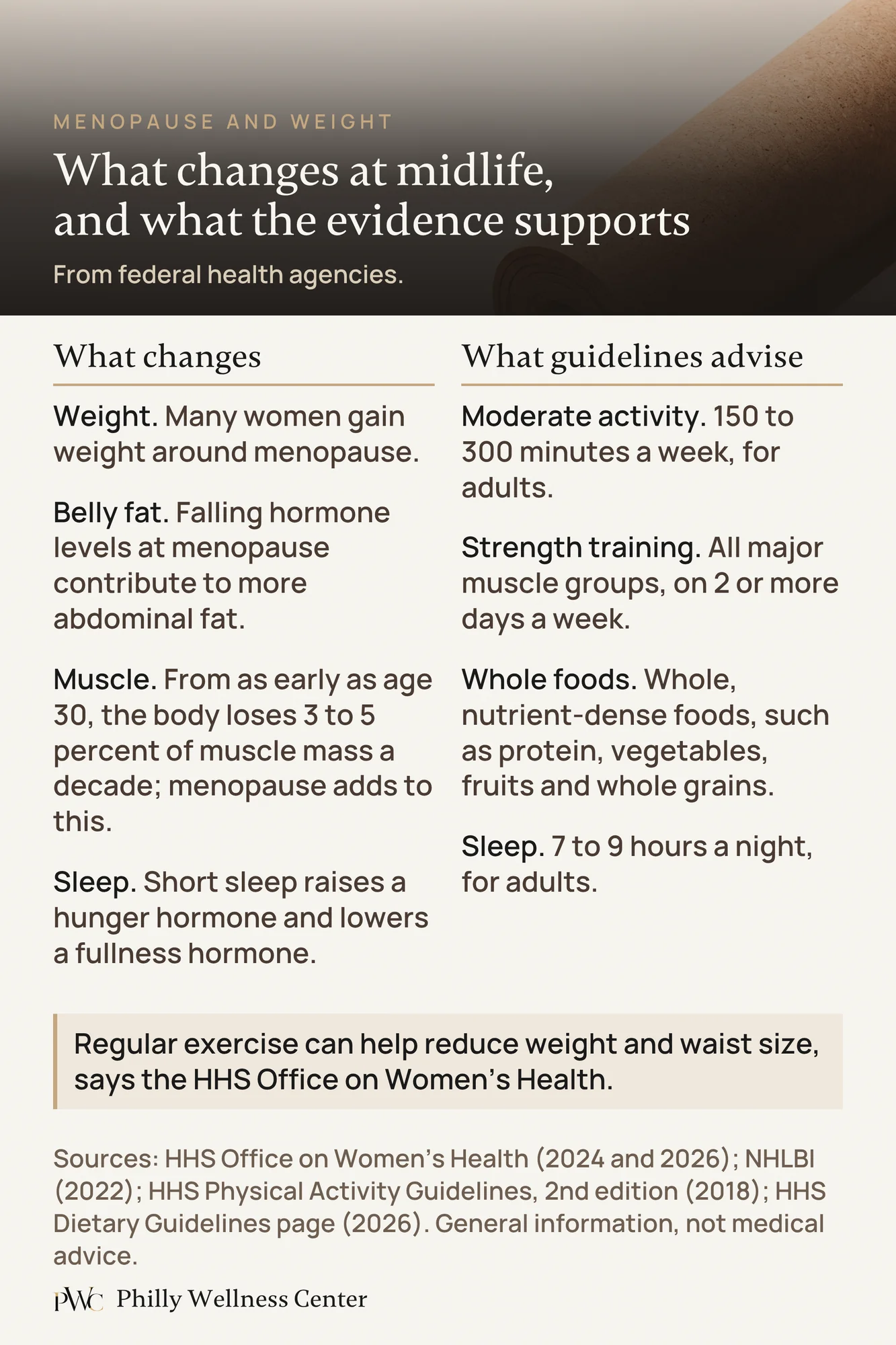
MedlinePlus explains that weight rises when more calories come in than the body uses, and says many different factors can affect weight gain, including surroundings, family habits, sleep and emotions. The Office on Women’s Health adds a midlife piece: falling hormone levels at menopause affect how muscles use energy and contribute to an increase in abdominal fat.
What is menopause belly?
Menopause belly is the everyday name for extra fat around the middle at midlife. The Office on Women’s Health says falling hormone levels at menopause contribute to an increase in abdominal fat. The same office says regular exercise can help reduce weight and waist size.
What happens to muscle at midlife?
The Office on Women’s Health says that starting as early as age 30, the body naturally starts to lose 3 to 5 percent of its muscle mass each decade, and that this change begins to become noticeable around age 60. It says the hormonal changes from menopause contribute to this natural decline.
For muscle loss, the office says exercise should focus on muscle health and include resistance and strength training, and that it is never too late to rebuild strength.
How does sleep affect weight at midlife?
Sleep can change at midlife. The Office on Women’s Health says menopause symptoms can affect sleep. MedlinePlus lists not enough sleep among the factors that affect weight gain, because people who do not get enough sleep may eat more calories and snack more.
The National Heart, Lung, and Blood Institute explains one reason: short sleep raises ghrelin, a hormone linked to hunger, and lowers leptin, a hormone linked to feeling full. MedlinePlus adds that regular exercise can help with sleep.
What helps with menopause weight gain?
Federal guidance points to the same habits it recommends for all adults. The Physical Activity Guidelines for Americans call for 150 to 300 minutes a week of moderate activity, plus muscle-strengthening activities on 2 or more days. The guidelines say physical activity can help people feel better, function better and sleep better.
Physical activity
The guidelines say adults should move more and sit less throughout the day. For vigorous activity, the range is 75 to 150 minutes a week.
Strength training
The guidelines call for working all major muscle groups. MedlinePlus says strength exercises make muscles stronger, and that lifting weights or using a resistance band can build strength.
Diet pattern
The U.S. Department of Health and Human Services says the Dietary Guidelines for Americans, 2025 to 2030, call for diets built on whole, nutrient-dense foods: protein, dairy, vegetables, fruits, healthy fats and whole grains. MedlinePlus adds eating more nutrient-rich foods, eating and drinking less of the foods and drinks that have lots of calories, salt, sugar and fat, and limiting alcohol. For muscle health, the Office on Women’s Health adds that a well-balanced diet should include healthy proteins.
Sleep
The Office on Women’s Health suggests a regular sleep routine: going to bed and getting up at the same time each day.
Is hormone therapy used to manage weight at menopause?
Not as an approved use. The U.S. Office on Women’s Health says the FDA has approved menopause hormone therapies for certain menopause symptoms and for preventing bone loss. Weight management is not on that list. The same page says hormone therapy has risks as well as benefits.
It adds that the risks depend on age, health history, and the type, dose and form of hormone therapy, and that decisions about hormone therapy are shared decisions made with a health care provider.
Frequently asked questions
Does activity have to happen all at once?
No. MedlinePlus says activity time can be broken down into short bursts throughout the day, and the Physical Activity Guidelines for Americans say some physical activity is better than none.
Do the federal activity guidelines apply to older adults?
Yes. The Physical Activity Guidelines for Americans say the key guidelines for adults also apply to older adults, who are also advised to include balance training.
Do these changes happen to every woman?
No. The Office on Women’s Health says menopause symptoms vary from person to person, and it describes weight gain as something many women experience. Questions about a specific case are best taken to a health care provider.
Where to start at Philly Wellness Center
Philly Wellness Center is at 834 South St, Philadelphia, PA 19147. Care for the menopause transition is led by Catie Harris, PhD, MBA, CRNP, a nurse practitioner. More on care at the clinic: perimenopause treatment in Philadelphia and menopause treatment in Philadelphia.
Book a free 15-minute phone call with the clinic’s patient coordinator
Or call (215) 709-9710.
Educational only, not medical advice.
Sources
- U.S. Department of Health and Human Services, Office on Women’s Health. “Menopause basics.” Page last updated October 19, 2026. Read November 5, 2026. womenshealth.gov/menopause/menopause-basics
- U.S. Department of Health and Human Services, Office on Women’s Health. “Menopause and your health.” Page last updated October 19, 2026. Read November 5, 2026. womenshealth.gov/menopause/menopause-and-your-health
- U.S. Department of Health and Human Services, Office on Women’s Health. “Menopause symptoms and relief.” Page last updated October 19, 2026. Read November 5, 2026. womenshealth.gov/menopause/menopause-symptoms-and-relief
- U.S. Department of Health and Human Services, Office on Women’s Health. “Menopause treatment.” Page last updated October 19, 2026. Read November 5, 2026. womenshealth.gov/menopause/menopause-treatment
- U.S. Department of Health and Human Services, Office on Women’s Health. Fact sheet on muscle loss and menopause. December 2024. Read November 5, 2026. womenshealth.gov
- U.S. National Library of Medicine, MedlinePlus. “Weight Control.” Last updated August 27, 2025. Read November 5, 2026. medlineplus.gov/weightcontrol
- U.S. National Library of Medicine, MedlinePlus. “Healthy Aging.” Last updated June 17, 2024. Read November 5, 2026. medlineplus.gov/healthyaging
- U.S. National Library of Medicine, MedlinePlus. “Exercise for Older Adults.” Last updated July 15, 2024. Read November 5, 2026. medlineplus.gov/exerciseforolderadults
- U.S. National Library of Medicine, MedlinePlus. “Menopause.” Last updated August 3, 2026. Read November 5, 2026. medlineplus.gov/menopause
- National Heart, Lung, and Blood Institute, National Institutes of Health. “How Much Sleep Is Enough?” Last updated March 24, 2022. Read November 5, 2026. nhlbi.nih.gov/health/sleep/how-much-sleep
- National Heart, Lung, and Blood Institute, National Institutes of Health. “Sleep Deprivation and Deficiency.” Last updated June 15, 2022. Read November 5, 2026. nhlbi.nih.gov/health/sleep-deprivation/health-effects
- U.S. Department of Health and Human Services. “Physical Activity Guidelines for Americans, 2nd edition: Executive Summary.” 2018. Read November 5, 2026. odphp.health.gov
- U.S. Department of Health and Human Services, Office of Disease Prevention and Health Promotion. “Dietary Guidelines for Americans.” Content last updated June 11, 2026. Read November 5, 2026. odphp.health.gov/our-work/nutrition-physical-activity/dietary-guidelines