Featured photo: AI-generated illustration.
By Philly Wellness Center
U.S. federal health guidance does not set out a separate menopause diet. The Dietary Guidelines for Americans, 2025 to 2030, say Americans should prioritize whole, nutrient-dense foods. Federal agencies also give guidance on protein, calcium and vitamin D, fiber, added sugars, sodium, alcohol and calorie needs that change with age.
The short version
- MedlinePlus lists 1,200 mg of calcium a day for women ages 51 to 70.
- The Office on Women’s Health lists 22 grams of fiber a day for women age 51 or older.
- A Dietary Guidelines fact sheet from the U.S. Department of Health and Human Services limits sodium to less than 2,300 mg a day and added sugars to 10 grams or less at each meal.
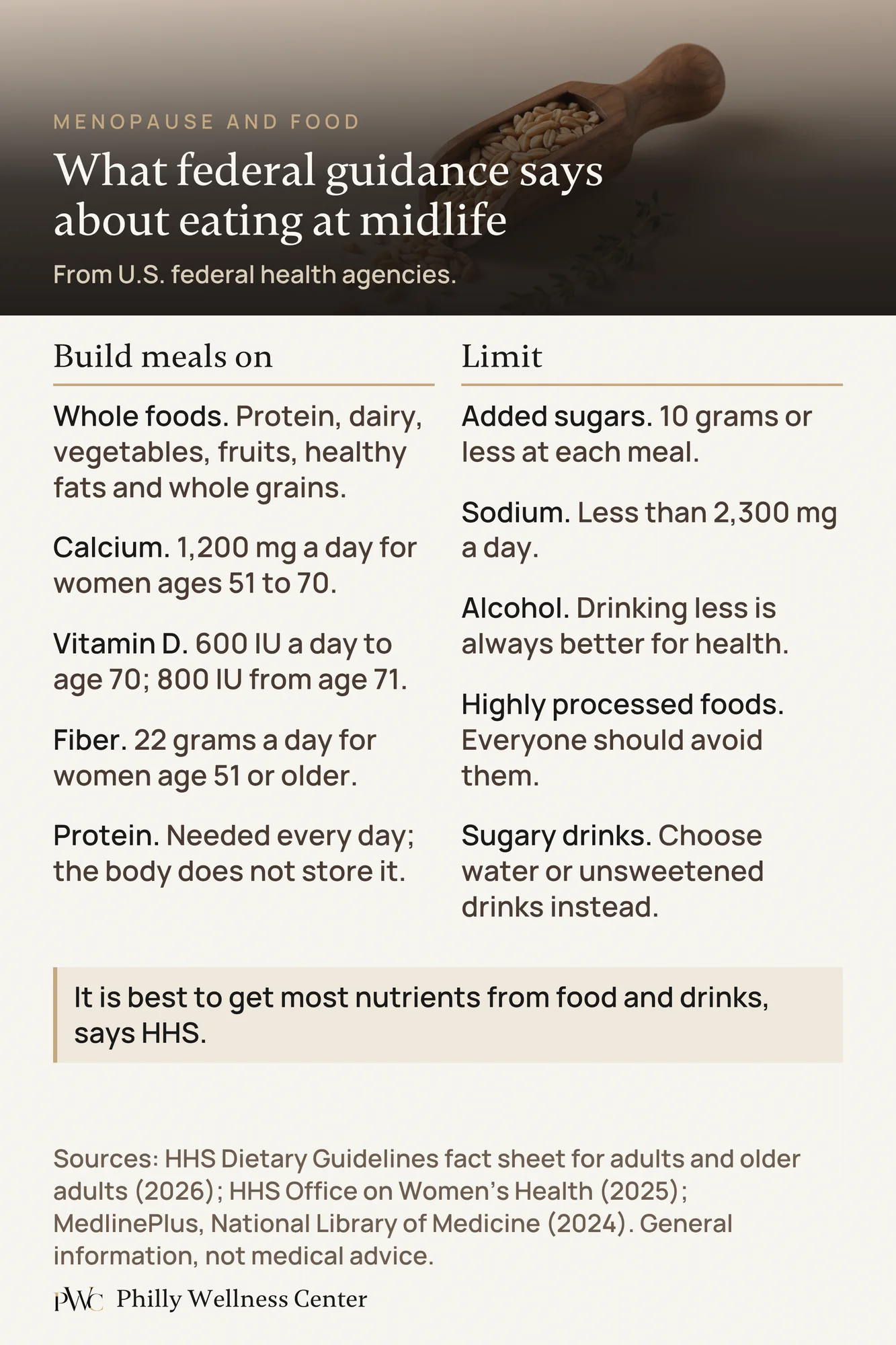
Infographic header photo: AI-generated illustration.
What is the menopause diet?
It is an everyday name for eating around menopause, not a federal eating plan. The U.S. Office on Women’s Health says healthy eating does not mean one specific diet or type of food, and that one of the keys to healthy eating is the overall pattern of eating rather than any one special ingredient.
The office adds that healthy eating does not require a very strict diet and is not limited to certain patterns of eating, such as high protein. When the menopause transition usually begins is covered in At What Age Does Menopause Start?
What is the best diet for menopause?
Federal guidance gives midlife women the same core eating pattern as all adults. The U.S. Department of Health and Human Services (HHS) says the current Dietary Guidelines, for 2025 to 2030, call on every American to eat more real food. Its fact sheet for adults lists six food groups: protein, dairy, vegetables, fruits, healthy fats and whole grains.
The fact sheet gives examples for each group. Protein foods include eggs, poultry, seafood and meat, plus beans, peas, lentils, nuts, seeds and soy. Dairy includes milk, yogurt and cheese. Healthy fats are found in foods such as salmon and other fatty fish, nuts, seeds, avocados and olive oil.
The Office on Women’s Health also names several eating plans to start with, including a Healthy U.S.-style plan, a Mediterranean-style plan and a vegetarian plan.
Why does protein matter with age?
Protein is part of how the body keeps its muscles. MedlinePlus, the National Library of Medicine’s health site, says the body needs protein from food to build and maintain bones, muscles and skin. It adds that the body does not store protein the way it stores fats or carbohydrates, so protein is needed every day.
MedlinePlus notes that most Americans eat enough protein, and that some older adults need more.
Why do calcium and vitamin D matter after menopause?
Both are tied to bone health, which changes after menopause. The Office on Women’s Health says bone is lost faster after menopause and that calcium from food supports the bones. MedlinePlus lists 1,200 mg of calcium a day for women ages 51 to 70, compared with 1,000 mg for adults ages 19 to 50.
MedlinePlus adds that the body absorbs and retains less calcium after menopause. It lists 600 IU of vitamin D a day for adults ages 19 to 70 and 800 IU from age 71. The HHS fact sheet says vitamin D helps the body absorb calcium to keep bones strong.
Food sources
For calcium, the HHS fact sheet names dairy products and fortified dairy alternatives, canned sardines and salmon, and leafy greens such as kale and bok choy. MedlinePlus adds calcium-enriched foods such as breakfast cereals and tofu. For vitamin D, the fact sheet names milk, yogurt and fish such as mackerel, salmon and trout. MedlinePlus notes that very few foods contain vitamin D naturally, and that most people get vitamin D in their diet from fortified foods.
How much fiber do women over 50 need?
The Office on Women’s Health says women age 51 or older need 22 grams of fiber a day, and that most women do not get enough. Its list of good sources includes fortified cereal, many whole-grain breads, beans, fruits (especially berries), dark green leafy vegetables, all types of squash, and nuts.
The HHS fact sheet says fiber can help people feel full longer, and names its role in regular digestion and heart health. The Office on Women’s Health suggests filling about half the plate with fruits or vegetables at meals, choosing whole fruit over juice, and making at least half of grains whole grains, such as brown rice or whole-wheat pasta.
Which foods and drinks do the guidelines say to limit?
Highly processed foods, added sugars, refined carbohydrates, sodium and alcohol. The HHS fact sheet says everyone should avoid highly processed foods, added sugars and refined carbohydrates. It limits added sugars to 10 grams or less at each meal and sodium to less than 2,300 mg a day, and says drinking less alcohol is always better for health.
The same fact sheet says no amount of added sugars is recommended as part of a healthy diet. It names sugar-sweetened drinks such as soda, fruit drinks and energy drinks, and suggests still water, sparkling water or unsweetened drinks instead. It also says the body may become more sensitive to sodium with age.
On a Nutrition Facts label, the fact sheet says, a percent Daily Value of 5 percent or less is generally considered low. MedlinePlus says most people in the U.S. get more sodium than they need, and that the Dietary Guidelines limit of 2.3 grams a day equals about 1 teaspoon of table salt. The National Heart, Lung, and Blood Institute suggests flavoring foods with herbs and spices instead of salt.
Do calorie needs change after menopause?
They tend to fall with age. The HHS fact sheet says calorie needs depend on age, weight, height, sex and physical activity. The Office on Women’s Health says most women need fewer calories as they age, because of less muscle and less physical activity.
On average, the office says, adult women need between 1,600 and 2,400 calories a day, and women who are more physically active may need more. The HHS fact sheet adds that aging can affect appetite and thirst: older adults might not feel as hungry, which can make it hard to get enough nutrients, and may not feel thirsty, so it advises drinking water or other fluids throughout the day.
How weight changes around menopause is covered in Menopause Weight Gain: What Changes, and What the Evidence Says Helps.
Frequently asked questions
Do caffeine, spicy foods or alcohol matter at menopause?
MedlinePlus lists avoiding alcohol, spicy foods and caffeine among the lifestyle changes for menopause symptoms, and says they can make those symptoms worse.
Is it better to get nutrients from food?
Yes, according to the HHS fact sheet, which says it is best to get most nutrients from food and drinks. The Office on Women’s Health says most women, most of the time, should get their essential nutrients from what they eat and drink.
Do frozen or canned vegetables and fruits count?
Yes. The HHS fact sheet says frozen, dried or canned vegetables and fruits are just as nutritious, can be more affordable and last longer. It advises choosing options with little or no added sugars or sodium.
Does eating with others help?
The HHS fact sheet says sharing meals with others can make healthy eating easier and more enjoyable, and suggests meals with friends and family or a neighborhood potluck.
Are these needs the same for everyone?
No. MedlinePlus says protein needs depend on age, sex, health and level of physical activity, and the HHS fact sheet suggests asking a health care provider whether eating less sodium is best. Questions about a specific case are best taken to a health care provider.
Where to start at Philly Wellness Center
Philly Wellness Center is at 834 South St, Philadelphia, PA 19147. Care for the menopause transition is led by Catie Harris, PhD, MBA, CRNP, a nurse practitioner. Treatment is individualized based on symptoms, laboratory findings, medical history, and ongoing monitoring. More on care at the clinic: perimenopause treatment in Philadelphia and menopause treatment in Philadelphia.
Book a free 15-minute phone call with the clinic’s patient coordinator
Or call (215) 709-9710.
Educational only, not medical advice.
Sources
- U.S. Department of Health and Human Services, Office of Disease Prevention and Health Promotion. “Healthy Eating for Adults and Older Adults.” Dietary Guidelines for Americans fact sheet, October 2026. Read November 7, 2026. odphp.health.gov
- U.S. Department of Health and Human Services, Office of Disease Prevention and Health Promotion. “Dietary Guidelines for Americans.” Content last updated June 11, 2026. Read November 7, 2026. odphp.health.gov/our-work/nutrition-physical-activity/dietary-guidelines
- U.S. Department of Health and Human Services, Office on Women’s Health. “Healthy eating and women.” Page last updated October 23, 2025. Read November 7, 2026. womenshealth.gov/healthy-eating/healthy-eating-and-women
- U.S. Department of Health and Human Services, Office on Women’s Health. “Menopause and your health.” Page last updated October 19, 2026. Read November 7, 2026. womenshealth.gov/menopause/menopause-and-your-health
- U.S. National Library of Medicine, MedlinePlus. “Dietary Proteins.” Last updated July 17, 2024. Read November 7, 2026. medlineplus.gov/dietaryproteins
- U.S. National Library of Medicine, MedlinePlus. “Nutrition for Older Adults.” Last updated March 13, 2024. Read November 7, 2026. medlineplus.gov/nutritionforolderadults
- U.S. National Library of Medicine, MedlinePlus. “Calcium.” Last updated May 14, 2024. Read November 7, 2026. medlineplus.gov/calcium
- U.S. National Library of Medicine, MedlinePlus. “Vitamin D.” Last updated May 10, 2024. Read November 7, 2026. medlineplus.gov/vitamind
- U.S. National Library of Medicine, MedlinePlus. “Sodium.” Last updated April 17, 2023. Read November 7, 2026. medlineplus.gov/sodium
- U.S. National Library of Medicine, MedlinePlus. “Menopause.” Last updated August 3, 2026. Read November 7, 2026. medlineplus.gov/menopause
- National Heart, Lung, and Blood Institute, National Institutes of Health. “Choose Heart-Healthy Foods.” Last updated December 10, 2025. Read November 7, 2026. nhlbi.nih.gov/health/heart-healthy-living/healthy-foods