
Featured photo: AI-generated illustration.
By Philly Wellness Center
Perimenopause and menopause are not the same thing. Perimenopause is the transition before menopause, when hormone levels and periods change. Menopause is the point reached after 12 months in a row with no period. Blood tests can show which way hormones are moving. Because levels change, results are read over time and with the cycle history.
The short version
- Perimenopause is a stretch of time. Menopause is a single point at the end of it.
- A provider reads hormone results with age, symptoms and the cycle history.
- FSH changes through the month and estrogen changes often, so one blood test may not show which stage it is.
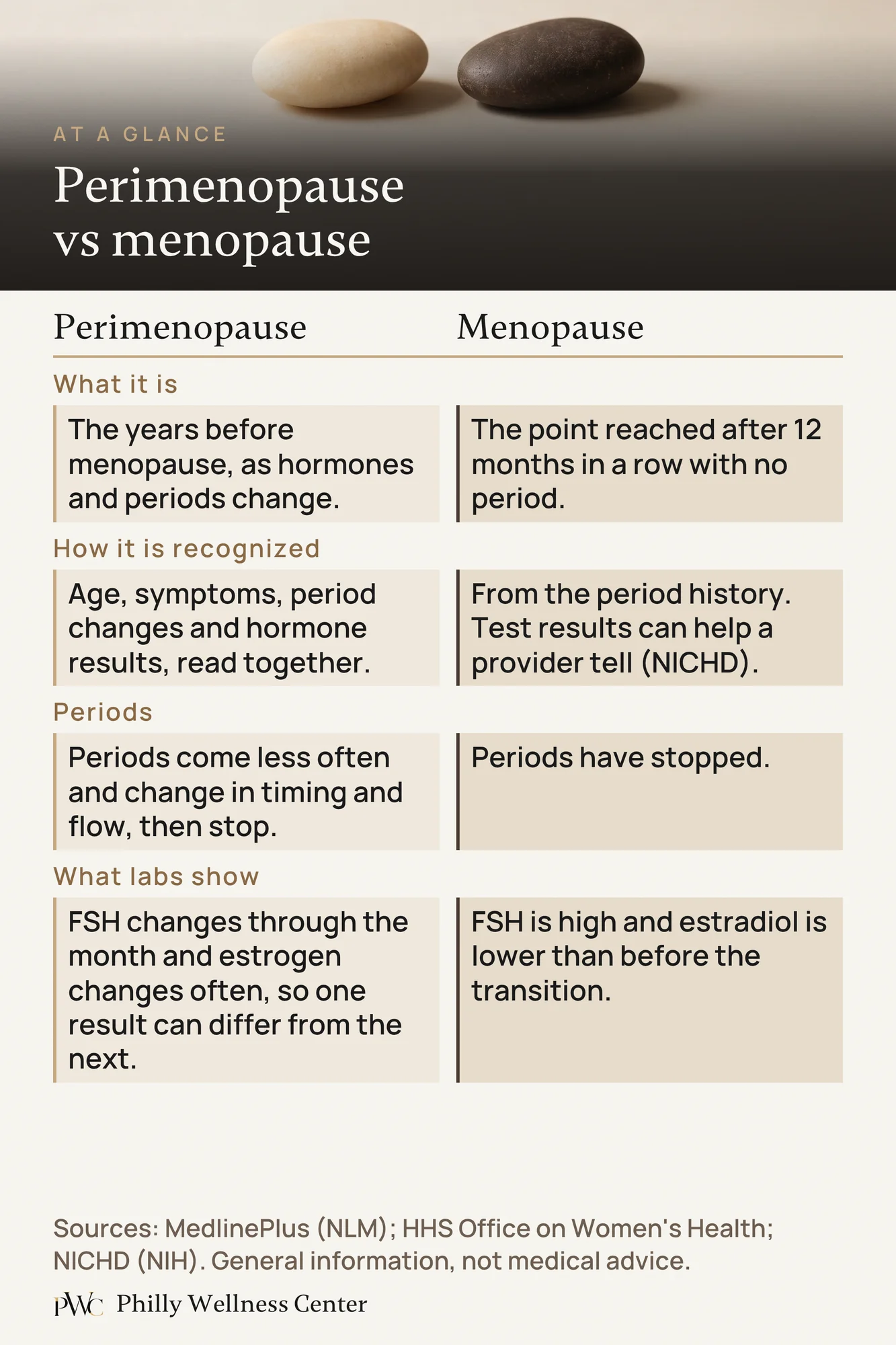
Infographic header photo: AI-generated illustration.
What is the difference between perimenopause and menopause?
Perimenopause is a stretch of time and menopause is a point in time. In the first, the ovaries make less estrogen and progesterone and periods may become irregular, according to NICHD and the Office on Women’s Health. The second is marked once 12 months have passed with no period, and after it the ovaries stop releasing eggs.
The three stages, perimenopause, menopause and postmenopause, are set out on the clinic’s page on perimenopause treatment in Philadelphia. How long each stage lasts is covered in Understanding Menopause: Exactly How Long Does Menopause Last?
Is perimenopause the same as menopause?
No, and the difference matters in practice. The Office on Women’s Health says pregnancy is still possible during perimenopause, even when periods are skipped, and that after menopause a woman no longer has periods and cannot get pregnant. It advises talking with a provider about the need for birth control.
How do periods change in each stage?
MedlinePlus says that during the menopausal transition periods may become irregular, with more or less time in between, and may be shorter or longer, lighter or heavier. NICHD says periods come less often and eventually stop. The Office on Women’s Health advises tracking periods and symptoms and sharing that record with a provider.
How is perimenopause recognized, and how is menopause confirmed?
A provider weighs several things together. MedlinePlus says an FSH result is read with age, symptoms, medical history and other hormone results, especially LH. Menopause is defined by 12 months in a row with no period, including no spotting. NICHD says a provider can also use test results to tell if a woman is in menopause.
What can blood tests show in perimenopause and menopause?
Blood tests can show which way hormones are moving. MedlinePlus says high levels of FSH, made by the pituitary gland, are a normal sign of perimenopause and menopause, as the ovaries release fewer eggs. NICHD says estradiol and other hormones decrease around menopause.
FSH, or follicle-stimulating hormone, helps control the menstrual cycle. Estradiol is the main estrogen during the childbearing years and is made mostly in the ovaries, MedlinePlus says. NICHD says providers can run blood or urine tests for estradiol, FSH and luteinizing hormone (LH), and that around menopause the ovaries respond less to FSH and LH, so the body makes more of them.
Another marker, anti-Müllerian hormone (AMH), falls as the supply of eggs shrinks. MedlinePlus says AMH drops to zero at menopause.
What can a single lab result not show?
A single result is one reading of a level that moves. MedlinePlus says estrogen levels in women change a lot, and that because they change so often, more than one test may be needed to look for a trend over time. So one result on its own may not show which stage it is.
- Reading a range. How a result is read against the range a lab prints is covered in Normal Hormone Labs: What a Reference Range Means, and What It Leaves Out.
- AMH cannot give a date. MedlinePlus says an AMH test cannot predict when menopause will actually happen.
- Medicines can change results. MedlinePlus says birth control pills and hormone therapy for menopause may need to be stopped before an estrogen test, but only when a provider says so.
That is why results may need to be timed and repeated, and are read with the cycle history and other results, so the trend shows what one draw cannot.
Frequently asked questions
Is perimenopause before or after menopause?
Before. Postmenopause is the stage after menopause.
Does age decide which stage it is?
No single age decides it. The usual ages are covered in At What Age Does Menopause Start?
Can a home test show perimenopause or menopause?
Not on its own. The FDA says home menopause tests measure FSH in urine and show only whether FSH is raised, and that the test does not detect menopause or perimenopause. MedlinePlus adds that home tests can only find higher than normal FSH levels.
Where to start at Philly Wellness Center
Philly Wellness Center is at 834 South St, Philadelphia, PA 19147. Care for the menopause transition is led by Catie Harris, PhD, MBA, CRNP, a nurse practitioner. Treatment is individualized based on symptoms, laboratory findings, medical history, and ongoing monitoring. More on care at the clinic: perimenopause treatment in Philadelphia and menopause treatment in Philadelphia.
Book a free 15-minute phone call with the clinic’s patient coordinator
Or call (215) 709-9710.
Educational only, not medical advice.
Sources
- U.S. National Library of Medicine, MedlinePlus. “Menopause.” Last updated August 3, 2026. Read November 5, 2026. medlineplus.gov/menopause
- U.S. National Library of Medicine, MedlinePlus. “Follicle-Stimulating Hormone (FSH) Levels Test.” Last updated December 4, 2023. Read November 5, 2026. medlineplus.gov/lab-tests/follicle-stimulating-hormone-fsh-levels-test
- U.S. National Library of Medicine, MedlinePlus. “Estrogen Levels Test.” Last updated July 30, 2025. Read November 5, 2026. medlineplus.gov/lab-tests/estrogen-levels-test
- U.S. National Library of Medicine, MedlinePlus. “Anti-Müllerian Hormone Test.” Last updated August 11, 2026. Read November 5, 2026. medlineplus.gov/lab-tests/anti-mullerian-hormone-test
- U.S. Department of Health and Human Services, Office on Women’s Health. “Menopause basics.” Page last updated October 19, 2026. Read November 5, 2026. womenshealth.gov/menopause/menopause-basics
- Eunice Kennedy Shriver National Institute of Child Health and Human Development (NICHD), National Institutes of Health. “About Menopause.” Last reviewed November 16, 2021. Read November 5, 2026. nichd.nih.gov/health/topics/menopause/conditioninfo
- NICHD, National Institutes of Health. “How do healthcare providers diagnose menopause?” Last reviewed November 16, 2021. Read November 5, 2026. nichd.nih.gov/health/topics/menopause/conditioninfo/diagnosed
- U.S. Food and Drug Administration. “Menopause” (Home Use Tests). Content current as of September 27, 2018. Read November 5, 2026. fda.gov/medical-devices/home-use-tests/menopause